








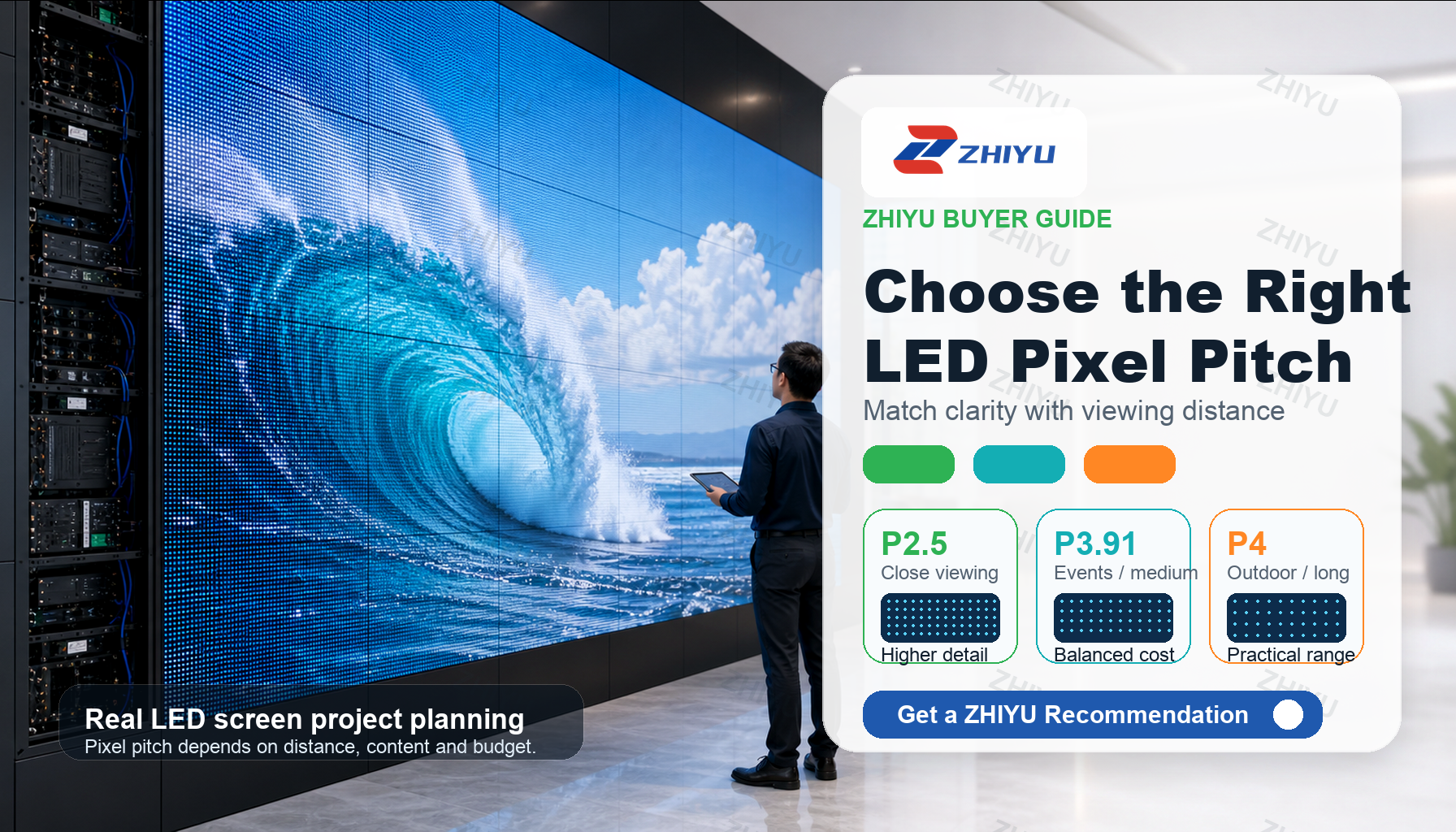
LED screen pixel pitch is one of the most important specifications buyers see in an LED display quotation. You may see options such as P2.5 LED screen, P3.91 LED screen そして P4 LED screen, but the best choice is not always the smallest number.
In simple terms, pixel pitch affects viewing distance, image clarity, resolution and cost. Therefore, buyers should choose pixel pitch based on the real project: screen size, audience distance, content type, indoor or outdoor environment, installation method and budget. In this ZHIYU buyer guide, we explain what pixel pitch means and how to compare P2.5, P3.91 and P4 before ordering.
CTA: Not sure whether to choose P2.5, P3.91 or P4? Send ZHIYU your screen size, closest viewing distance, application and installation environment. Our team can recommend a practical LED screen pixel pitch for your project.
What Does LED Screen Pixel Pitch Mean?
LED screen pixel pitch is the distance from the center of one LED pixel to the center of the next LED pixel. It is usually measured in millimeters. For example, a P2.5 LED screen has about 2.5mm spacing between adjacent pixels, while a P4 LED screen has about 4mm spacing.
Because smaller pixel pitch places more pixels in the same screen area, it usually provides higher pixel density and better close-viewing clarity. However, it also increases the number of LED pixels, receiving points and processing requirements. As a result, smaller pixel pitch often costs more than larger pixel pitch at the same screen size.
Barco explains pixel pitch as the center-to-center distance between pixels, while Planar notes that pixel pitch directly determines pixel density. Christie also connects pixel pitch with viewing distance and warns that over-specifying pitch can increase cost without improving the viewer experience enough to justify it.
Image suggestion: Close-up LED module macro showing the center-to-center distance between LED pixels. Alt text: LED screen pixel pitch center to center distance explained.
Why Pixel Pitch Matters for Viewing Distance
Viewing distance is the main reason pixel pitch matters. If viewers stand close to a large-pitch LED screen, they may notice individual pixels or rough edges. However, when viewers stand farther away, the same screen can look smooth because the eye blends the pixels into one image.
A common starting rule is simple: each millimeter of pixel pitch can correspond to about one meter of minimum viewing distance. For example, P2.5 can start around 2.5 meters, P3.91 around 3.9 meters and P4 around 4 meters. This is not a strict engineering rule, but it gives buyers a useful first filter.
For a more comfortable planning distance, Christie also uses an optimal-distance approach based on pixel pitch. Using a pitch x 3 meters guide, P2.5 is around 7.5 meters, P3.91 is around 11.7 meters and P4 is around 12 meters. In real projects, the final decision also depends on content detail, viewing expectations, screen size and budget.
P2.5 vs P3.91 vs P4 LED Screen Viewing Distance
The table below gives a practical buyer-friendly comparison. Use it as a starting point, not as a fixed rule for every project.
Image suggestion: Comparison infographic showing P2.5, P3.91 and P4 with approximate minimum and comfortable viewing distances. Alt text: P2.5 P3.91 P4 LED screen viewing distance comparison.
| Pixel Pitch | Approx. Close Viewing Start | Comfortable Planning Distance | Common Business Uses | Buyer Note |
|---|---|---|---|---|
| P2.5 | About 2.5m+ | About 7.5m+ | Retail, lobby, showroom, church, meeting room, close indoor viewing | Sharper at close range, usually higher cost than P3.91 or P4 |
| P3.91 | About 3.9m+ | About 11.7m+ | Stage rental, events, churches, medium-distance indoor/outdoor use | Popular balance between clarity, cabinet availability and cost |
| P4 | About 4m+ | About 12m+ | Outdoor signage, event backdrops, larger venues, long-distance viewing | Very close to P3.91 visually; often chosen for cost and product fit |
CTA: Share your audience distance with ZHIYU. If your closest viewers stand 3 meters away, P2.5 may make more sense than P4. If your audience stands 10 to 20 meters away, P3.91 or P4 may be more cost-effective.
P2.5 LED Screen: When Does It Make Sense?
A P2.5 LED screen works well when viewers stand relatively close to the display and need clear details. Many buyers use P2.5 in retail stores, corporate lobbies, showrooms, churches, meeting spaces, schools and control-style environments where text, product images, presentations or detailed video content matter.
Because P2.5 has higher pixel density than P3.91 and P4, it can make edges, text and fine visuals look smoother from a shorter distance. Also, it can help a business create a more premium impression when the LED wall is part of the customer experience.
However, P2.5 is not automatically the best choice. If viewers stand far away, the extra pixel density may not create enough visible improvement. In that case, a larger pitch may give the project a better balance between image quality and budget.
P3.91 LED Screen: Why It Is Popular for Events and Rental
A P3.91 LED screen is common in rental LED display, stage LED wall, church events, exhibitions, conferences and medium-distance viewing. It offers a practical balance between visual quality, cabinet cost, assembly speed and audience distance.
For many events, the audience does not stand extremely close to the screen. Therefore, P3.91 can look smooth enough while keeping the project more cost-efficient than fine-pitch indoor options. It also appears often in rental cabinet systems because many event projects need fast setup, repeated handling and flexible screen sizes.
Still, buyers should check indoor or outdoor use, brightness, refresh rate, cabinet weight, locking system and service access. Pixel pitch is important, but it is only one part of the final LED screen solution.
P4 LED Screen: Practical for Outdoor and Long-Distance Viewing
Buyers often choose a P4 LED screen for outdoor signage, larger venues, event backdrops and commercial displays viewed from a longer distance. Since P4 has slightly larger pixel spacing than P3.91, it may reduce cost or match certain cabinet systems better.
For outdoor projects, brightness, weather protection, cabinet structure and safe maintenance access may matter more than the small difference between P3.91 and P4. If viewers stand far enough away, P4 can still deliver a strong image while keeping the budget under control.
Therefore, buyers should not reject P4 only because the number is larger. Instead, compare it with actual viewing distance, screen size, content detail and total project cost.
P3.91 vs P4 LED Screen: Is There a Big Difference?
The difference between P3.91 and P4 is very small: only 0.09mm in pixel pitch. In many real business projects, viewers will not notice a dramatic visual difference if the screen size, content and viewing distance are similar.
Because the visual gap is small, other factors can become more important. These include cabinet size, product series, rental compatibility, brightness, refresh rate, waterproof design, availability, spare parts and price. For example, an event company may choose P3.91 because it matches a common rental cabinet system, while an outdoor signage buyer may choose P4 because it fits the budget and viewing distance better.
Buyer note: If you are comparing P3.91 and P4, ask the supplier for full specifications, not just pixel pitch. ZHIYU can help compare cabinet design, brightness, refresh rate, installation method and service plan.
How Pixel Pitch Changes LED Screen Resolution
Pixel pitch also changes the approximate resolution of the same physical screen size. The calculation is simple: screen width in millimeters divided by pixel pitch gives approximate horizontal pixels. Screen height in millimeters divided by pixel pitch gives approximate vertical pixels.
For example, a 4m x 2m LED screen is 4000mm wide and 2000mm high. The approximate pixel counts are very different across P2.5, P3.91 and P4.
Image suggestion: 4m x 2m LED screen example comparing approximate resolution for P2.5, P3.91 and P4. Alt text: LED screen resolution comparison for P2.5 P3.91 and P4 pixel pitch.
| Screen Size | Pixel Pitch | Approx. Resolution | What It Means |
|---|---|---|---|
| 4m x 2m | P2.5 | About 1600 x 800 px | Higher detail for closer viewing and text-heavy content |
| 4m x 2m | P3.91 | About 1023 x 511 px | Balanced for medium-distance viewing and events |
| 4m x 2m | P4 | About 1000 x 500 px | Close to P3.91, often practical for longer viewing distance |
This is why two LED screens with the same physical size can have very different prices and visual performance. Smaller pixel pitch increases resolution, but it also requires more pixels and more processing capacity.
CTA: Need help calculating LED screen resolution? Send ZHIYU your screen width, height and target pixel pitch. We can estimate the resolution and recommend a suitable control system.
Indoor vs Outdoor Pixel Pitch Selection
Indoor LED screens often need smaller pixel pitch because viewers stand closer. Retail stores, meeting rooms, lobbies and showrooms may use P2.5 or finer options when visual detail matters. Churches and halls may use P2.5, P3.91 or another pitch depending on room size and audience distance.
Outdoor LED screens often use larger pixel pitch because viewers stand farther away. However, outdoor selection also depends on brightness, weather protection, cabinet structure, heat management and safe maintenance access. Therefore, P4 or larger pitch can be practical when the audience views the screen from a distance.
Image suggestion: Indoor retail/lobby, church/event and outdoor signage examples mapped to different pixel pitch choices. Alt text: Indoor outdoor and event LED screen pixel pitch selection guide.
Do Not Choose Pixel Pitch by Price Alone
A lower price can look attractive, but the wrong pixel pitch can reduce the display effect. If the pitch is too large for close viewing, viewers may see rough pixels. If the pitch is much smaller than needed, the buyer may spend more without a clear visual benefit.
Also, pixel pitch should work with other specifications. Brightness, refresh rate, grayscale, color calibration, cabinet flatness, service method and control system all affect the final result. For example, a P2.5 screen with weak processing or poor calibration may not look better than a well-configured P3.91 screen at the right viewing distance.
For this reason, ZHIYU recommends comparing the complete LED screen solution instead of comparing only the pitch number.
How ZHIYU Recommends Pixel Pitch for Buyers
ZHIYU starts with your project conditions before recommending pixel pitch. First, we check the screen size and closest viewing distance. Next, we review indoor or outdoor use, content type, installation method and budget target. Then, we compare suitable options such as P2.5, P3.91, P4 or other pitches.
This process helps buyers avoid both over-specification and under-specification. In other words, you do not pay for unnecessary fine pitch, and you do not choose a pitch that looks rough from your audience position.
Final CTA: Send ZHIYU your screen size and viewing distance. We will help recommend the suitable LED screen pixel pitch, resolution, cabinet type, control system and maintenance plan for your project.
FAQ: LED Screen Pixel Pitch, P2.5, P3.91, P4 and Viewing Distance
What does LED screen pixel pitch mean?
LED screen pixel pitch is the distance from the center of one LED pixel to the center of the next LED pixel, usually measured in millimeters. Smaller pixel pitch means higher pixel density and clearer images at closer viewing distances.
What is the viewing distance for a P2.5 LED screen?
As a practical starting point, P2.5 can support closer viewing from about 2.5 meters and is often comfortable for detailed business content at around 7.5 meters or more. The final choice depends on content, screen size and viewing expectations.
What is the difference between P3.91 and P4 LED screen?
P3.91 and P4 are very close in pixel pitch. P3.91 has slightly higher pixel density, while many buyers choose P4 for long-distance viewing, outdoor signage or cost-efficient projects. In many business projects, cabinet design, brightness and availability matter more than the small 0.09mm pitch difference.
Is a smaller LED pixel pitch always better?
No. Smaller pixel pitch can improve close-viewing clarity, but it also increases cost and resolution requirements. If viewers stand far away, a larger pixel pitch may deliver a better balance between image quality and budget.
What information does ZHIYU need to recommend LED pixel pitch?
ZHIYU needs your screen width and height, closest viewing distance, indoor or outdoor environment, application, content type, installation method and budget target to recommend a suitable LED screen pixel pitch.
Choose the Right Pixel Pitch for the Real Viewing Distance
LED screen pixel pitch should help the display look clear from the real audience position. A P2.5 pitch is useful for closer and more detailed viewing. Many event and medium-distance projects use P3.91 as a balanced option. Outdoor signage, larger venues and longer viewing distances can make P4 practical.
However, the best choice depends on more than the pitch number. Screen size, viewing distance, content detail, indoor or outdoor use, installation method and budget all matter. Therefore, the right way to choose is to compare the complete LED screen project.
Contact ZHIYU for a pixel pitch recommendation. Send us your screen size, viewing distance and application. We will help you choose a practical LED screen solution before ordering.