







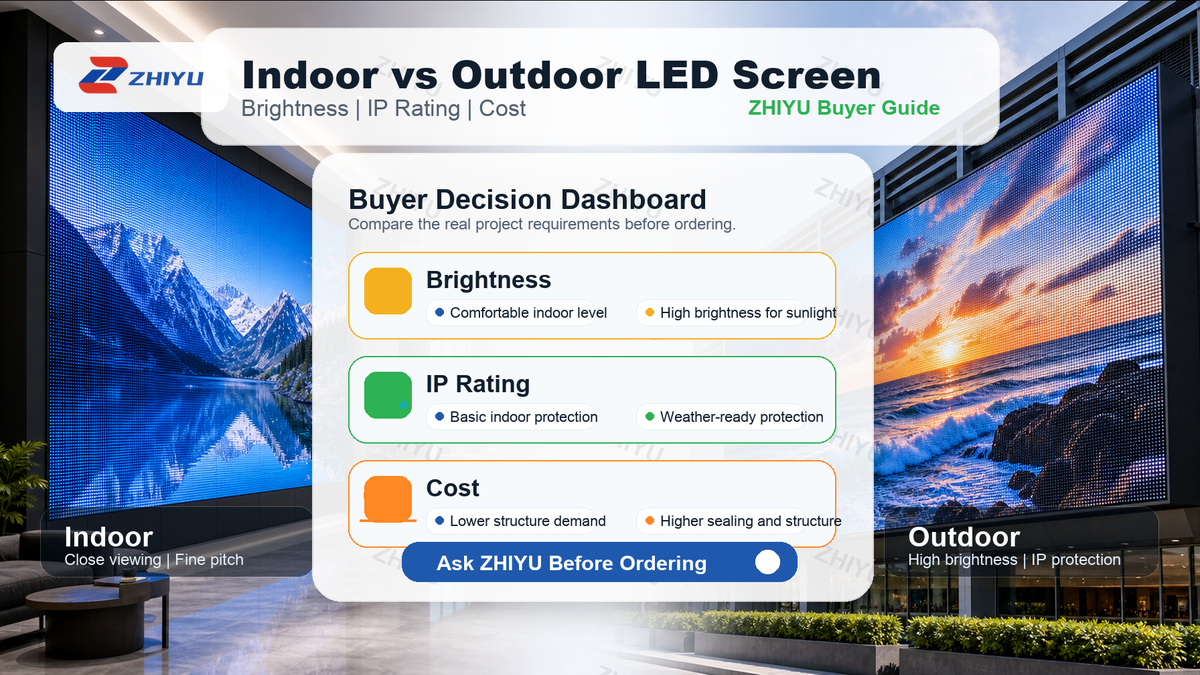
Choosing between an indoor and outdoor LED screen is not only a location question. It affects brightness, IP rating, cabinet structure, installation, maintenance access, power planning and total cost. If buyers compare only the screen size or pixel pitch, they may miss the real project requirements.
In this ZHIYU buyer guide, we explain how indoor and outdoor LED screens differ, why outdoor displays usually need stronger protection, and how brightness and IP rating affect the final project budget. The goal is simple: help you choose the right LED display before ordering.
CTA: Need help choosing indoor or outdoor LED? Send ZHIYU your screen size, environment, sunlight condition, viewing distance and installation method. Our team can recommend suitable brightness, pixel pitch, cabinet type, IP protection and maintenance access.
Indoor vs Outdoor LED Screen: The Main Difference
An indoor LED screen works in a controlled environment. It usually faces lower ambient light, more stable temperature, less dust, no rain and closer viewing distance. Therefore, buyers often focus on pixel pitch, color quality, refresh rate, cabinet thickness and front-service design.
An outdoor LED screen must survive a more demanding environment. It may face direct sunlight, rain, dust, wind, temperature changes, humidity and longer operating hours. As a result, outdoor buyers must review brightness, weather protection, IP rating, heat management, steel structure, service access and electrical safety.
Buyer note: A screen installed behind glass is not automatically an outdoor screen. However, a window-facing LED display may still need higher brightness because sunlight can reduce visibility. Tell ZHIYU whether the screen is indoor, outdoor, semi-outdoor or window-facing before comparing quotations.
Brightness: Why Outdoor LED Screens Need More Nits
Brightness is one of the biggest differences between indoor and outdoor LED screens. Indoor spaces usually need comfortable brightness for people standing nearby. If the screen is too bright indoors, it can feel harsh and may waste power.
Outdoor displays face a different challenge. Sunlight, glare and changing weather can reduce screen visibility, so outdoor LED screens often need much higher brightness. Samsung notes that outdoor signage needs high brightness to combat glare, while adaptive brightness can help optimize visibility as ambient light changes. LG also lists outdoor LED products with 5,000-nit brightness and IP65-rated designs, showing how brightness and durability often come together in outdoor product planning.
However, higher brightness is not always better. The right level depends on sunlight direction, viewing distance, content type, operating schedule and local power conditions. Therefore, buyers should not choose brightness by one number only.
Image suggestion: Visual comparison of indoor, window-facing and outdoor brightness environments with sun glare and ambient light indicators. Alt text: Indoor outdoor and window facing LED screen brightness comparison.
| Environment | Brightness Priority | Typical Buyer Focus |
|---|---|---|
| Indoor LED screen | Comfortable brightness for close viewing | Pixel pitch, color, refresh rate, clean installation |
| Window-facing LED screen | Higher brightness to overcome glass and sunlight | Sun direction, heat, content visibility, power use |
| Outdoor LED screen | High brightness for sunlight and weather changes | Brightness, IP rating, cabinet strength, service access |
CTA: Share the sunlight condition with ZHIYU. Tell us whether the screen faces direct sun, shade, glass, night-time viewing or all-day operation. We can recommend a practical brightness range for your project.
IP Rating: What It Means for LED Screens
IP rating describes how well an enclosure protects against solids and liquids. Intertek explains that IEC 60529 rates enclosures of electrical and electronic devices against dust, liquids and access to hazardous parts. In simple terms, the first digit relates to solid object or dust protection, while the second digit relates to water protection.
For example, IP65 means the product has a high level of dust protection and protection against water jets under defined test conditions. It does not mean the display can be installed anywhere without structure, drainage, cable protection or maintenance planning. Also, some LED products have different front and rear IP ratings, so buyers should check both sides.
Image suggestion: Clean diagram explaining first IP digit for solids/dust and second IP digit for water, with IP20, IP54 and IP65 examples. Alt text: LED screen IP rating explained for indoor and outdoor display cabinets.
| IP Example | Common Meaning for Buyers | Where It May Fit |
|---|---|---|
| IP20 | Basic indoor protection, not for rain or outdoor dust exposure | Controlled indoor LED screen |
| IP54 | Dust-protected and protected against splashing water under defined conditions | Semi-protected or rear-side design, depending on product |
| IP65 | Dust-tight and protected against water jets under defined conditions | Many outdoor LED cabinet fronts or outdoor-rated systems |
Buyer note: Do not treat IP rating as a complete installation plan. Outdoor LED projects still need correct sealing, drainage, cable routing, power protection, ventilation, structure and safe service access.
CTA: Ask ZHIYU to confirm front and rear IP rating. Before outdoor installation, confirm whether the cabinet front, rear, connectors, power box and service direction match the real weather conditions.
Indoor LED Screen: What Buyers Should Check
Indoor LED screens usually serve retail stores, lobbies, meeting rooms, churches, schools, hotels, showrooms and control-style spaces. In these environments, viewers often stand closer to the screen, so pixel pitch and image detail matter.
Since indoor screens do not usually face rain or direct outdoor dust, buyers can focus more on visual performance and installation appearance. A fine-pitch LED screen may fit close viewing, while a larger indoor LED wall may use a balanced pitch for medium-distance audiences.
Also, indoor buyers should check front-service design, cabinet depth, wall structure, power access, signal routing, refresh rate, grayscale and content source. A clean installation can matter as much as the technical specification because the display becomes part of the business space.
Outdoor LED Screen: What Buyers Should Check
Outdoor LED screens serve storefronts, building facades, roadside advertising, sports venues, public squares, transportation areas and outdoor events. These projects need higher visibility and stronger mechanical protection than indoor screens.
First, buyers should check brightness and viewing direction. Next, they should review IP rating, cabinet material, heat dissipation, wind-load structure, waterproof power and signal routing. Finally, they should plan maintenance access before production, because service can become difficult after a large outdoor display is mounted.
Outdoor LED screens may also need more detailed local preparation. For example, a building facade display may require steel structure drawings, power distribution, cable protection, waterproof junctions and local installation labor. As a result, the total project cost includes much more than the LED cabinet price.
Why Outdoor LED Screen Cost Is Usually Higher
Outdoor LED screen cost is usually higher because the system must handle a harsher environment. Higher brightness increases LED and power requirements. Weather-ready cabinets require stronger sealing and materials. IP-rated design adds engineering, testing and production complexity.
In addition, outdoor projects often require heavier support structures, safer installation, waterproof power distribution, heat management, ventilation, packaging and more careful shipping. Maintenance access can also raise cost because technicians need safe ways to reach modules, power supplies, receiving cards and cables.
Image suggestion: Cost stack comparing indoor LED screen and outdoor LED screen: brightness, waterproof cabinet, steel structure, power, cooling, maintenance and shipping. Alt text: Indoor vs outdoor LED screen cost breakdown including brightness IP rating and installation.
| Cost Factor | Indoor LED Screen | Outdoor LED Screen |
|---|---|---|
| Brightness | Comfortable indoor level | Higher brightness for sunlight and glare |
| Cabinet protection | Indoor cabinet design | Weather-ready and IP-rated cabinet design |
| Structure | Wall frame or indoor support | Steel structure, wind-load and outdoor mounting |
| Power and heat | Lower environmental stress | More demanding power, cooling and protection |
| Maintenance | Often easier access indoors | Needs safe outdoor service planning |
CTA: Request a complete project quote, not only a cabinet price. ZHIYU can help compare product cost, structure preparation, installation support, spare parts and long-term maintenance needs.
Window-Facing and Semi-Outdoor LED Screens
Some projects sit between indoor and outdoor. A window-facing LED screen may be installed indoors, but it still faces strong sunlight through glass. A semi-outdoor display may sit under a canopy, inside an entrance or in a partially protected area.
These projects need careful discussion. They may not require the same full outdoor cabinet design, but they may need higher brightness, better heat management and stronger protection than a normal indoor LED wall. If the screen faces afternoon sun or sits behind reflective glass, visibility can become a major issue.
Therefore, buyers should share photos, installation drawings and sunlight direction with ZHIYU. With that information, we can recommend whether an indoor, window-facing, semi-outdoor or outdoor LED screen makes sense.
Installation and Maintenance: Plan Before Production
Installation planning should start before production, especially for outdoor LED displays. The project team should confirm screen size, cabinet layout, mounting structure, power distribution, signal routing, service direction and safety access.
For indoor projects, buyers should check wall strength, cabinet thickness, front service and cable path. For outdoor projects, buyers should also check waterproof cable exits, heat dissipation, drainage, wind-load structure, grounding and service platform needs.
Image suggestion: Technician checking outdoor LED cabinet sealing, cables, power supply and service access. Alt text: Outdoor LED screen installation maintenance and waterproof cabinet service access.
CTA: Plan structure, power and service access before production. Send ZHIYU site photos, drawings or measurements so we can help review the basic installation direction.
Indoor vs Outdoor LED Screen Buying Checklist
Before requesting a quote, prepare the basic project information. This helps ZHIYU recommend the right configuration instead of sending a generic price list.
Image suggestion: Checklist showing indoor/outdoor, sunlight, IP rating, brightness, screen size, viewing distance, mounting structure and destination country. Alt text: Indoor outdoor LED screen quotation checklist before ordering from ZHIYU.
- Indoor, outdoor, semi-outdoor or window-facing environment
- Screen width and height, or available installation area
- Closest and typical viewing distance
- Sunlight direction, shade condition and operating time
- Wall-mounted, hanging, floor-standing, truss-mounted or steel-structure installation
- Required front service, rear service or both
- Expected content type, such as ads, video, text, menus, live camera or presentations
- Brightness expectation and IP protection needs
- Destination country, shipping terms and installation schedule
- Budget range and after-sales expectations
CTA: Send this checklist to ZHIYU. With your environment, size, viewing distance and installation details, we can recommend a practical indoor or outdoor LED screen solution.
FAQ: Indoor vs Outdoor LED Screen
What is the main difference between indoor and outdoor LED screens?
Indoor LED screens are designed for controlled spaces and closer viewing, while outdoor LED screens need higher brightness, weather protection, stronger cabinet structure, IP-rated design, heat management and safe service access.